
Showing posts with label Thanjavur. Show all posts
Showing posts with label Thanjavur. Show all posts
Monday, February 20, 2017
The Art Of Tanjore Painting
No comments:
Labels:
Chennai,
handword,
tanjore painting,
Thanjavur,
thanjavur painting,
traditional painting
One of the most popular form of classical South Indian painting, the Tanjore Painting, is know for its elaborate relief work, dense composition and vibrant colors. It’s surface richness and various embellishments distinguishes it from other types of paintings. The subjects of most of the paintings are Hindu deities and saints. Tanjore Painting gets its name from the ancient pronunciation of the place where it originated, which was then called Thanjavur. It originated during the 16th century, under the reign of the Cholas. Tanjore was the capital of the mighty Chola Empire. The Chola rulers besides being great warriors were builders of magnificent temples and great patrons of arts. It was against this setting that this highly specialized form of art with its characteristically beautiful ornamental relief work flourished. Today, hundreds of dedicated artists, mostly based in Tamil Nadu, India, are keeping this age long tradition alive.
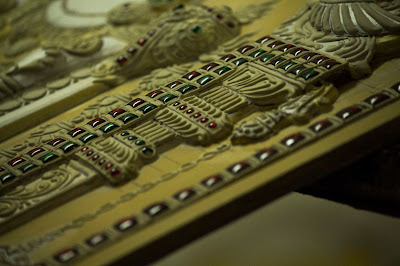
One such artist, Raja, has been practicing this craft for the last 16 years. Working from a tiny room in his house located on south mada road, Thiruvanmiyur, he does the relief work before passing it on to another artist who then adds the gold leaf, color and frames the paintings. Due to the commercialization of the craft, the work is divided amongst artisans to increase the output and reduce the time invested on one painting.
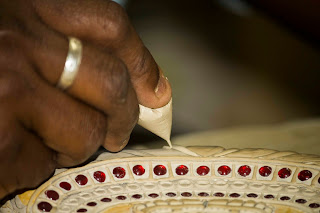
Raja begins the process by smoothening the plywood on which muslin is then stuck using fevicol. A layer of chalk powder mixed with fevicol is applied on the cloth and it is left to dry. It is then coated with arabic gum. After the canvas has been prepped, the drawing is traced on from a gateway sheet to ensure uniformity in the work. Tracing the drawing is also done to save time. Once the drawing is done, depending on whether it’s a flat, semi embossed or 3d embossed, the various layers of chalk powder and plaster of paris are applied. The entire process takes him 2-4 days after which it is packed it thermacol and bubble wrap and sent to the next artist for the further process. The next artist sticks the gold foil on using Arabic gum and then finishes the painting with poster paint. The last thing to be painted on are the god/goddesses eyes as it is believed that once they are painted on the god enters the painting.
 A typical Thanjavur painting consists of one main figure, a deity, with a well-rounded body & almond shaped eyes, which is the typical Dravidian structure. This figure is housed in an enclosure created by means of an arch, curtains etc. The painting is bordered and highlighted by the gilded and gem-set technique - a technique used predominantly in all Tanjore paintings, where gold leaves & sparkling stones are used to highlight certain aspects of the painting like ornaments, dresses etc. The paintings are bright & colourful and breathtakingly beautiful.
Over a period of time many changes have occurred in the style and form of painting - for example, the figures are no longer too round, showing the changed preferences in body structures. Presiding deities of various famous temples are also being depicted in the more recent paintings.
The artists lead simple lives even though Tanjore paintings are very expensive as the middlemen make most of the money, paying the artistes a bare minimum. Moreover, artists who have not been trained in the craft have also started practicing it, which reduces its authenticity. People purchase these paintings, as they are cheaper than the authentic ones. Still they continue to put their heart and soul into each painting they make and because of these efforts made by the modern day artists Tanjore Paintings have become the symbol of traditional paintings. One can say that Tanjore painting is one of the finest and the most visually beautiful forms of classical paintings in South India.
Contact
Name - Mr. Raja
Documented by Anushka Harish Salian
Read More
One such artist, Raja, has been practicing this craft for the last 16 years. Working from a tiny room in his house located on south mada road, Thiruvanmiyur, he does the relief work before passing it on to another artist who then adds the gold leaf, color and frames the paintings. Due to the commercialization of the craft, the work is divided amongst artisans to increase the output and reduce the time invested on one painting.
Raja begins the process by smoothening the plywood on which muslin is then stuck using fevicol. A layer of chalk powder mixed with fevicol is applied on the cloth and it is left to dry. It is then coated with arabic gum. After the canvas has been prepped, the drawing is traced on from a gateway sheet to ensure uniformity in the work. Tracing the drawing is also done to save time. Once the drawing is done, depending on whether it’s a flat, semi embossed or 3d embossed, the various layers of chalk powder and plaster of paris are applied. The entire process takes him 2-4 days after which it is packed it thermacol and bubble wrap and sent to the next artist for the further process. The next artist sticks the gold foil on using Arabic gum and then finishes the painting with poster paint. The last thing to be painted on are the god/goddesses eyes as it is believed that once they are painted on the god enters the painting.
Over a period of time many changes have occurred in the style and form of painting - for example, the figures are no longer too round, showing the changed preferences in body structures. Presiding deities of various famous temples are also being depicted in the more recent paintings.
Contact
Name - Mr. Raja
Contact Number - +(91)-9840541546
Address - 48/67a, South mada street, Thiruvanmiyur, Chennai - 600041, Opposite alm Pranav hotel
Documented by Anushka Harish Salian
Wednesday, February 8, 2017
The Bobblehead Bommais of Thanjavur
No comments:
Labels:
bobblehead,
craft,
dolls,
thalayatti bommai,
Thanjavur
Thanjavur Doll is a unique and antique product from Thanjavur city. This doll is a part of Thanjavur’s traditional arts. Previously it used to be only made in Thanjore but now it’s being produced in all parts of Tamil Nadu. The dolls are well known for its elegant movements and steps like a dancer. Traditionally known as Thanjavur Thalaiyatti Bommai (Thalaiyatti means ‘Shaking head’ and Bommai means ‘Doll’), are a part of an exquisite heritage of beautiful handicrafts from Thanjavur.

History:
The significance of these amazing dolls is intertwined with the history of the region, and dates back to the early 19th century during King Saraboji’s reign. His passion for colors and art evolved to be the root cause of this beautiful structure. Thanjavur Thalaiyatti Bommai is generally a pair of king and queen and in their doll-like sembalance symbolise the many dynasties that homed Thanjavur. These dolls have a next level charm about them, with a cordial and welcoming aura which can be attributed to the dancing style in which they seem to greet everyone mainly by shaking their heads ( which is their most striking feature) and moving their body in a continuous, oscillating movement.
Why thalaiyatti bommais are special?
It is quite interesting to note how the doll’s centre of gravity was identified and used during the early days. The doll’s total weight is concentrated on the bottom most central all the time. The round bottomed toy comes in sitting, standing and rotating types. Some artists tend to design thanjavur thalaiyatti bommai with a sense of humor.
Thanjavur dolls are sold extensively during navratri season. This is when the dolls are used as part of the golus. Myths and legends states that the tanjore racking dolls are used to showcase the downfall and upliftment of life. Nearly 9 racks are decorated with these beautiful little creations.

Process:
Clay from the banks of Cauvery, the river by which Thanjavur is situated, is used in its making. Plaster of Paris and paper pulp are mixed along with tuber gum in a dough-like consistency. Then the dough is beaten up to mix it well and is flattened to put it proportionally on the desired mould. This dough is pressed into moulds to make the front and back panels of the doll. Once dry, the panels are removed from the moulds and paper is stuck on them. Tuber gum is used to seal the front and back of the hollow doll as well as the seam that joins the clay-filled rounded base. Once the mould is dry, all the four parts are individually smoothened with sandpaper slowly. Oil paints are then used to coat them. Paints used in these dolls are of various colours.

Current Scenario:
There is a huge demand for papier mache dolls in the past few years. The Doll making industry is growing day by day.
As one of the artisan stated that there is also a high demand for dolls form NRIs. They have started frequenting the area to place orders for custom-made dolls. They ask for papier-mâché dolls not more than five inches high so that they can be transported to their countries easily. They give the design or photograph for the doll of their choice. Nowadays people want innovative sets of dolls for theme-based ‘Kolu’ arrangements during Navarathri. Women in the area have formed self-help groups and run their own production units. They get loans from the government and function in groups of 15 members. This has not only given us additional source of income, but has also instilled confidence in them.
Contact Details Located In: 1st Street, Lakshmi Nagar, Velachery
Contact: 9042308508
Working Hours: 09:00 to 18:00
Documented by Urvashi
History:
The significance of these amazing dolls is intertwined with the history of the region, and dates back to the early 19th century during King Saraboji’s reign. His passion for colors and art evolved to be the root cause of this beautiful structure. Thanjavur Thalaiyatti Bommai is generally a pair of king and queen and in their doll-like sembalance symbolise the many dynasties that homed Thanjavur. These dolls have a next level charm about them, with a cordial and welcoming aura which can be attributed to the dancing style in which they seem to greet everyone mainly by shaking their heads ( which is their most striking feature) and moving their body in a continuous, oscillating movement.
Why thalaiyatti bommais are special?
It is quite interesting to note how the doll’s centre of gravity was identified and used during the early days. The doll’s total weight is concentrated on the bottom most central all the time. The round bottomed toy comes in sitting, standing and rotating types. Some artists tend to design thanjavur thalaiyatti bommai with a sense of humor.
Thanjavur dolls are sold extensively during navratri season. This is when the dolls are used as part of the golus. Myths and legends states that the tanjore racking dolls are used to showcase the downfall and upliftment of life. Nearly 9 racks are decorated with these beautiful little creations.
Process:
Clay from the banks of Cauvery, the river by which Thanjavur is situated, is used in its making. Plaster of Paris and paper pulp are mixed along with tuber gum in a dough-like consistency. Then the dough is beaten up to mix it well and is flattened to put it proportionally on the desired mould. This dough is pressed into moulds to make the front and back panels of the doll. Once dry, the panels are removed from the moulds and paper is stuck on them. Tuber gum is used to seal the front and back of the hollow doll as well as the seam that joins the clay-filled rounded base. Once the mould is dry, all the four parts are individually smoothened with sandpaper slowly. Oil paints are then used to coat them. Paints used in these dolls are of various colours.
Current Scenario:
There is a huge demand for papier mache dolls in the past few years. The Doll making industry is growing day by day.
As one of the artisan stated that there is also a high demand for dolls form NRIs. They have started frequenting the area to place orders for custom-made dolls. They ask for papier-mâché dolls not more than five inches high so that they can be transported to their countries easily. They give the design or photograph for the doll of their choice. Nowadays people want innovative sets of dolls for theme-based ‘Kolu’ arrangements during Navarathri. Women in the area have formed self-help groups and run their own production units. They get loans from the government and function in groups of 15 members. This has not only given us additional source of income, but has also instilled confidence in them.
Contact Details Located In: 1st Street, Lakshmi Nagar, Velachery
Contact: 9042308508
Working Hours: 09:00 to 18:00
Documented by Urvashi
Subscribe to:
Posts (Atom)


