
Showing posts with label Chennai. Show all posts
Showing posts with label Chennai. Show all posts
Saturday, May 13, 2017
Craft of Political Graffiti in Chennai
No comments:
Labels:
Chennai,
graffiti,
painting,
political graffiti,
politics,
street art,
wall painting
Street art, with its focus on images and artistry, has become a primary mode of public expression in international metropolises and a global language for citizens to articulate sociopolitical criticisms all the while expressing individual artistry. When one walks through the streets of Chennai, it is hard to miss the street art that colour the walls. From bold Tamil slogans to portraits of politicians, Chennai exhibits a different culture of street art. The concept of street art or graffiti has evolved over time in every aspect. Themes, motivations, mind sets and tools have changed with time. Interestingly, street art in Chennai is a perfect blend of the traditional with the modern and the local with the global.
It is often said that politics is the art and technique of government. Every idea has an intention, similarly political idea also has the intention for implementation, but many people see this with negative mindset. It includes the activities to stay in power or to influence the government policies. It also includes the law- making policies and procedure. Political parties are indispensable for the working of modern democratic governments. The importance of Political parties lies in the fact that democracies cannot function without the existence of political parties.
 For years now the canvas of the artist has been expanding. One no longer has to limit oneself to the boundaries of paper or cloth. The walls of the cityscape with their ever-widening horizons have turned into the media on which several artists choose to project their creativity. While there is no formal definition of street art, one can introduce this practice as one where artists leave behind their impressions on walls. Using paint brushes, cans of spray-paint, stencils, fingers, hands, and the like, as instruments, they mark the walls, either casually, or with political intentions; and sometimes the walls simply become an outlet for their creativity. One could associate it with a child doodling on her first blank sheet of paper.
While graffiti has traditionally been highly controversial, the advent of iconographic street art has opened new platforms for international youth to creatively express sociopolitical discontent. Ironically, Indian artists have been using graffiti like techniques for ages, right from store name boards and signages to movie posters and public service announcements, so the actual “influence” per se was to voice opinions about what may be considered taboo in the once conservative society of India. Indian artists such as Daaku, (also known as the Indian Banksy), are inspired to create and voice out common dillemas and current affairs, in public places and more.
 Before the age of televisions and broadcast, the sole method of public awareness were wall paintings. With the vibrant and standard party associated colors, the party and the artist intended to create associative cognitive learning from spectating the grafffiti that illustrates the concerned parties colors, representatives name and style Tamil Nadu Graffiti stands apart from the regular kind globally with its incorporation of typography, colors and visual hierarchy.
The previous DMK-led corporation council spent nearly 4.5 crore to paint nearly 15 lakh sqft of walls with murals depicting among other things rural life, shore temples of Mamallapuram and the Vivekananda Rock. Last year, the AIADMK-led council whitewashed all walls and is now clueless about what to do with them. Earlier, it planned to paint the government’s achievements on them.
But a casual gaze at the abandoned walls, street corners and even the beaches in the city, reveals a colourful blend of political portraits, vibrant graffiti and even modern art, created by those who are mostly called perpetrators of vandalism a.k.a. the street artists of Chennai.
While the poorer neighbourhoods in the city mostly contain political portraits and graffiti, as one moves down south towards the more affluent part of the city, the politicians and their various moods captured on enamel are replaced with spray paintings that are mostly an expression of angst by the angry, young city artist.

In the northern suburb of Ayanavaram, Chennai resides Mr. Kalai Cholai an artist by profession and a philosopher by night. He specialises in the art of wall painting and practises the same without any bias. He is humble, kind and wise as he tell me (an aspiring artist myself) how painting the shabby wall gives him spiritual peace of mind and keeps his skills trained. “Its all about scales” he says.
The design process begins with the client or the company the artist works on a tenure period with a party giving the artist an assigned artwork for a wall along with its dimensions. .Soon after that , the artist plans his scale and and the specifics of the image/ typography to be painted on. According to Mr. Kalaicholai an experienced artist’s sometimes do not use the grid and prefer free hand drawing, however the less experienced amateur artists use the ruler and grid plans to verify scaling.
The artist now evauates and budgetises the project and requests for it followed by receiving the same and spending it on the project. The artist now does a simple white was with putty to get the desired and apt background . They then paint sketch over the background post drying and paint it in. Once the first layer is done, the artist makes necessary changes, color corrections, and gradations .
note: the thickness/ number of coats of paints varies from wall to wall, i.e the grainier, the more layers and graffiti wont be considered as vandalism as long as the owner of the wall is awake and approving of it.
Read More
It is often said that politics is the art and technique of government. Every idea has an intention, similarly political idea also has the intention for implementation, but many people see this with negative mindset. It includes the activities to stay in power or to influence the government policies. It also includes the law- making policies and procedure. Political parties are indispensable for the working of modern democratic governments. The importance of Political parties lies in the fact that democracies cannot function without the existence of political parties.

While graffiti has traditionally been highly controversial, the advent of iconographic street art has opened new platforms for international youth to creatively express sociopolitical discontent. Ironically, Indian artists have been using graffiti like techniques for ages, right from store name boards and signages to movie posters and public service announcements, so the actual “influence” per se was to voice opinions about what may be considered taboo in the once conservative society of India. Indian artists such as Daaku, (also known as the Indian Banksy), are inspired to create and voice out common dillemas and current affairs, in public places and more.
The previous DMK-led corporation council spent nearly 4.5 crore to paint nearly 15 lakh sqft of walls with murals depicting among other things rural life, shore temples of Mamallapuram and the Vivekananda Rock. Last year, the AIADMK-led council whitewashed all walls and is now clueless about what to do with them. Earlier, it planned to paint the government’s achievements on them.
But a casual gaze at the abandoned walls, street corners and even the beaches in the city, reveals a colourful blend of political portraits, vibrant graffiti and even modern art, created by those who are mostly called perpetrators of vandalism a.k.a. the street artists of Chennai.
While the poorer neighbourhoods in the city mostly contain political portraits and graffiti, as one moves down south towards the more affluent part of the city, the politicians and their various moods captured on enamel are replaced with spray paintings that are mostly an expression of angst by the angry, young city artist.

In the northern suburb of Ayanavaram, Chennai resides Mr. Kalai Cholai an artist by profession and a philosopher by night. He specialises in the art of wall painting and practises the same without any bias. He is humble, kind and wise as he tell me (an aspiring artist myself) how painting the shabby wall gives him spiritual peace of mind and keeps his skills trained. “Its all about scales” he says.
The design process begins with the client or the company the artist works on a tenure period with a party giving the artist an assigned artwork for a wall along with its dimensions. .Soon after that , the artist plans his scale and and the specifics of the image/ typography to be painted on. According to Mr. Kalaicholai an experienced artist’s sometimes do not use the grid and prefer free hand drawing, however the less experienced amateur artists use the ruler and grid plans to verify scaling.
The artist now evauates and budgetises the project and requests for it followed by receiving the same and spending it on the project. The artist now does a simple white was with putty to get the desired and apt background . They then paint sketch over the background post drying and paint it in. Once the first layer is done, the artist makes necessary changes, color corrections, and gradations .
note: the thickness/ number of coats of paints varies from wall to wall, i.e the grainier, the more layers and graffiti wont be considered as vandalism as long as the owner of the wall is awake and approving of it.
Thursday, March 9, 2017
Amazing Wood carving in chennai
No comments:
Labels:
Chennai,
craft,
sculpture,
wood carving,
woodwork
Wood carving is found all over India. We can see carved wooden pillars and doorways in temples and palaces across the country.and now, wood carving is mostly found in functional articles like furniture, bowls, boxes, lamp stands, etc. Depending on the availability, different types of woods were used for wood carving, and for making decorative wood installations. The origins of the craft can be traced back to the late 19th century which is Closely associated with architecture, wood carving incorporated the design vocabulary of architectural carvings.

HOW TO GET STARTED
First Select wood that is appropriate size and shape. For bigger art pieces more than one piece of wood can be used. Always Softer wood is easier to carve, but will also get damage easier. Then next is shaping process which is done using gouge of various sizes. The gouge is a curved blade that can remove large portions of wood smoothly.For harder woods, the sculptor may use a chisel and mallet, similar to a stone carver. For making Smaller sculptures they use knife and for making larger pieces they might require the use of a saw. No matter what wood is selected or tool used, the wood sculptor must always carve either across or with the grain of the wood, never against the grain. Once the general shape is made, the carver starts using variety of chisels for creating details. They use a V tool for making fine lines or decorative cuts.The finer polishing is done with abrasive paper. After completing the carving ad finishing the artist starts sealing and coloring the woods using various natural oils inorder to protect those woods from dirt and moisture. They use gloss varnish to get a shiny surface. And then they will do a final coating with a layer of wax which protects the wood and gives shiny soft lustrous sheen

Types of tools used for wood carving is as follows
1. The carving knife: a specialized knife used to pare, cut, and smooth wood.
2. The gouge: a tool with a curved cutting edge used in a variety of forms and
3. The coping saw, a small saw that is used to cut off chunks of wood at once.
4. The chisel, large and small, whose straight cutting edge is used for lines and cleaning up flat surfaces.
5. The V-tool used for parting, and in certain classes of flat work for emphasizing lines.
6. The veiner: a specialized deep gouge with a U shaped cutting edge.
sharpening equipment, such as various stones and a strop, necessary for maintaining edges.

ABOUT THE ARTISAN
MR. Ram Bhaskar is 42 year old wood carving art craftsman comes from a family of traditional craftsmen in uttar pradesh. While his forefathers carved ivory and sandalwood. Ram mostly uses palm wood. He has a experience of 38 years and works opposite max store, near tvs showroom, at Kottivakkam in ECR, chennai.
Read More
First Select wood that is appropriate size and shape. For bigger art pieces more than one piece of wood can be used. Always Softer wood is easier to carve, but will also get damage easier. Then next is shaping process which is done using gouge of various sizes. The gouge is a curved blade that can remove large portions of wood smoothly.For harder woods, the sculptor may use a chisel and mallet, similar to a stone carver. For making Smaller sculptures they use knife and for making larger pieces they might require the use of a saw. No matter what wood is selected or tool used, the wood sculptor must always carve either across or with the grain of the wood, never against the grain. Once the general shape is made, the carver starts using variety of chisels for creating details. They use a V tool for making fine lines or decorative cuts.The finer polishing is done with abrasive paper. After completing the carving ad finishing the artist starts sealing and coloring the woods using various natural oils inorder to protect those woods from dirt and moisture. They use gloss varnish to get a shiny surface. And then they will do a final coating with a layer of wax which protects the wood and gives shiny soft lustrous sheen
Types of tools used for wood carving is as follows
1. The carving knife: a specialized knife used to pare, cut, and smooth wood.
2. The gouge: a tool with a curved cutting edge used in a variety of forms and
3. The coping saw, a small saw that is used to cut off chunks of wood at once.
4. The chisel, large and small, whose straight cutting edge is used for lines and cleaning up flat surfaces.
5. The V-tool used for parting, and in certain classes of flat work for emphasizing lines.
6. The veiner: a specialized deep gouge with a U shaped cutting edge.
sharpening equipment, such as various stones and a strop, necessary for maintaining edges.
ABOUT THE ARTISAN
MR. Ram Bhaskar is 42 year old wood carving art craftsman comes from a family of traditional craftsmen in uttar pradesh. While his forefathers carved ivory and sandalwood. Ram mostly uses palm wood. He has a experience of 38 years and works opposite max store, near tvs showroom, at Kottivakkam in ECR, chennai.
Documented by Krishna Soman
Tuesday, March 7, 2017
Serial Light Cutout Craft
No comments:
Labels:
art installation,
Chennai,
craft,
Cutout Craft,
lighting,
Serial Lights,
street art
The craft of serial light cutout is being practiced in many parts all over the world, Tamilnadu among them has the most significance for the craft. This craft is a part of the culture in Tamilnadu, The practice of Serial light cutouts began when kollywood stepped into commercial phase, movies were made to make money. Movies moved on from art to commercial, during this phase hero worship spread rapidly among fans, which turned the fans, as well as the stars, turn into rivals. Fans made paintings of their actor in gigantic sizes in theaters to show off that their actor is the best among all.
 Paintings were made by splitting the image into many small pieces, painted separately and put in a structure which holds them together. But it was only visible in daylight, to make it also visible in night fans decided to use serial light cutouts which gloriously stood out in theaters during evening shows. From this point, this art of making cutouts from serial lights was made commercial. For the same reasons, this crafts was used in temple festivals and political party meetings. It acted an indication for the event which happened in that place.

The process of this crafts begins with sourcing bamboos which are already cut and ready to use. The required image is scaled and divided into parts using grids, The floor in the workshop have grids engraved which make the construction of bamboo grid easier. The image is sketched on the floor and grid constructed over them. Thinner strands of flexible bamboos are used to make the outlines and serial lights are fixed on them. Once various parts are created it is put together in the structure constructed. The artisans are electricians who also possess the aesthetic knowledge, the craft not necessarily goes on from father to child, but anyone interested can take up the craft. Materials used are bamboos, serial lights and GI wires to secure them. Currently, the craft is facing rapid development as it is used for many events.
Location of the workshop – Porur
Artisan – Hari
Contact - 09840561225
Documented by S V Aravindh Raj
Read More

The process of this crafts begins with sourcing bamboos which are already cut and ready to use. The required image is scaled and divided into parts using grids, The floor in the workshop have grids engraved which make the construction of bamboo grid easier. The image is sketched on the floor and grid constructed over them. Thinner strands of flexible bamboos are used to make the outlines and serial lights are fixed on them. Once various parts are created it is put together in the structure constructed. The artisans are electricians who also possess the aesthetic knowledge, the craft not necessarily goes on from father to child, but anyone interested can take up the craft. Materials used are bamboos, serial lights and GI wires to secure them. Currently, the craft is facing rapid development as it is used for many events.
Location of the workshop – Porur
Artisan – Hari
Contact - 09840561225
Documented by S V Aravindh Raj
Sunday, February 26, 2017
Shadow play of leather puppets
No comments:
Labels:
bommalattam,
Chennai,
Crafts of South India,
leather puppets,
puppetry,
puppets,
shadow puppets,
storytelling
Story telling has always been a part of humans since time immemorial. Starting from the cave paintings, man has always been interested in narrating and listening to stories. Mr. A. Selvaraja is one such inspiring person who comes from a family that holds a legacy of an ancient art, Leather puppets (or shadow puppets).
Thol bommalatam or shadow puppet is said to be one of the oldest crafts of India. Shadow puppets are flat colourful puppets, made from leather, which are operated against the rear of a tightly stretched white cloth. They are pressed against the cloth with strong source of light behind it and handled with thin bamboo sticks stuck to them. The arms have movable joints so that they can be moved in a specific way.The puppeteer holds the puppet by the lower end of the bamboo stick with one hand, and with a stick in the other hand, they manoeuver the puppet to perform the desired movements. It usually takes around 8 to 10 people to conduct the puppet show, a few for handling the puppets and the rest for playing music. His family has been a part of this art form for nearly a century. He was born into a family of puppeteers, where his ancestors are said to have been puppeteers at the court of the Sarafoji kings of Tanjore.

Preparing the leather puppets is a tedious process, that often takes a couple of days to make even the smallest of the lot. The puppets were considered to be a priced possession. Earlier, the puppets were made of deer skin and painted with natural organic dyes, which were considered to be the most valuable. The skin is treated in the sun for hours and the pulled and stretched. The process in repeated a couple of times until the leather becomes translucent so as to allow the light to pass through it.
 Puppetry that started as a court entertainment exclusively for royalties, slowly started coming out for the view of general public. Ramayana was the first ever story to be performed on the shows. Later, different stories like Harichandra, Pragalath were performed at the cause of teaching morals to people especially children. When the British rule took over India, the puppeteers were left to fend for themselves. They started moving from place to place pitching tents in one village after the other and performing for the locals. They would often settled in the villages for months, met new people, made friends and left a piece of their heart as they left. Their life was a beautiful adventure every other month.
All this slowly started coming to an end, as television started blooming and one day it totally swept of the puppetry. Presently, Mr. Selvaraja is sadly one among a very few people in the state to perform and make leather puppets. He performs in Dakshin Chitra for tourists every weekend, for four shows per day. He manipulates the plot of the story every week according to important current events.
Contact :
Mr. A. Selvaraja Naidu,
No.211, pillar kovil big street,Kolathur village,
via vandalur-mambakkam,
kanchipuram district
Mobile No.- 09444671029
Dakshin Chitra puppet show timings - 11am, 12am, 3pm and 4pm (every weekend)
Read More
Thol bommalatam or shadow puppet is said to be one of the oldest crafts of India. Shadow puppets are flat colourful puppets, made from leather, which are operated against the rear of a tightly stretched white cloth. They are pressed against the cloth with strong source of light behind it and handled with thin bamboo sticks stuck to them. The arms have movable joints so that they can be moved in a specific way.The puppeteer holds the puppet by the lower end of the bamboo stick with one hand, and with a stick in the other hand, they manoeuver the puppet to perform the desired movements. It usually takes around 8 to 10 people to conduct the puppet show, a few for handling the puppets and the rest for playing music. His family has been a part of this art form for nearly a century. He was born into a family of puppeteers, where his ancestors are said to have been puppeteers at the court of the Sarafoji kings of Tanjore.
Preparing the leather puppets is a tedious process, that often takes a couple of days to make even the smallest of the lot. The puppets were considered to be a priced possession. Earlier, the puppets were made of deer skin and painted with natural organic dyes, which were considered to be the most valuable. The skin is treated in the sun for hours and the pulled and stretched. The process in repeated a couple of times until the leather becomes translucent so as to allow the light to pass through it.
 |
| Gearing up for a show |
Contact :
Mr. A. Selvaraja Naidu,
No.211, pillar kovil big street,Kolathur village,
via vandalur-mambakkam,
kanchipuram district
Mobile No.- 09444671029
Dakshin Chitra puppet show timings - 11am, 12am, 3pm and 4pm (every weekend)
Saturday, February 25, 2017
Banana Fibre weaving at Anakaputhur
No comments:
Labels:
anakaputhur,
banana fiber,
Chennai,
eco fiber,
textiles,
weaving
India is a land where people believed on Nature largely - used Plants as a source for medicines, food, garments etc. As time went by, people changed to using different combinations of fibres, artificial fibres. Now the cycle is back to going green. Global warming is a major threat to mankind and the world is slowly moving towards Eco-Fashion. And this is turning to be a beneficial one for the whole of weaving industry sector.
Banana fiber is one among the few fibres which has been widely used for making garments in recent years. In India, approximately 5 lakh tonnes of Banana trunk is discarded as waste every year, after harvested. India is one of the leading producers of Banana in the world. Fibre can be extracted from the trunks of Banana. Also, Banana grows faster than other plants which makes them easily available. Banana fibre, infact, is one of the most useful products in Indian Market.

Anakaputhur is one of the places where Banana fibre is used extensively in the making of garments and household products. Anakaputhur is a suburb of Chennai that lies on the banks of Adyar. Anakaputhur was once famous for its traditional weaving business, which has declined due to modern competition, this place seems to bursting it seams, unable to cope up with rapid urbanisation. Anakaputhur with its lost name, is now gaining fame for a small eco-friendly initiative.
For the last 15 years, C Shekar, a weaver, has been quietly making fabrics out of vazhai naaru (banana fibre), inspired by the traditional weavers of Philippines. Sekar is famous for his works and brings together 12 self-help women groups under the banner of AJWA to extract banana fibre, turn it into yarn and weave yardage and sarees. With a population of about 25,000, Anakaputhur has only 750 handloom weavers today. Its decreasing in recognition and that is why this part of the city needs attention.

The extraction of fibre from Banana requites care to avoid damage. Banana plant sections are cut from the stem of the plant and rolled lightly to remove the excess moisture. Impurities in the rolled fibre are removed manually by means of comb and then is cleaned and dried. Once its dried, the banana sheaths are picked out and succulent flesh is scraped off with quick strokes till the fibres are visible.
 To make it as a yarn, the extracted threads of varying sizes are dried
and knotted to make it usable on a handloom. After this, the yarn is
handed over to the weavers. Once it reaches the weavers, it is spun into
a bobbin. The threaded bobbin is placed in water until it can be used
on the loom. It is inserted into the wooden shuttle that is passed
through the silk or cotton wrap, making the banana fibre yarn the weft
in the loom. The dyeing can be done in two stages: either as yarn or
after the fabric is woven, and in artificial dyes or natural ones.
To make it as a yarn, the extracted threads of varying sizes are dried
and knotted to make it usable on a handloom. After this, the yarn is
handed over to the weavers. Once it reaches the weavers, it is spun into
a bobbin. The threaded bobbin is placed in water until it can be used
on the loom. It is inserted into the wooden shuttle that is passed
through the silk or cotton wrap, making the banana fibre yarn the weft
in the loom. The dyeing can be done in two stages: either as yarn or
after the fabric is woven, and in artificial dyes or natural ones.
In recent years, the commercial value of Banana fibre has increased and Anakaputhur plays an important role in it. It is used all over the world for various purposes for making tea bags and sanitary napkins to currency notes and car tyres. Banana stem, hitherto considered waste is now being made into banana-fibre cloth which comes in differing weights and thickness.
The reducing number of people practising this craft has left a void for the next generation to take up this craft. The people working have been provided with low wages which is affecting the craft.
Contact: C Shekar
Documented by Ajay Kumar
Read More
Banana fiber is one among the few fibres which has been widely used for making garments in recent years. In India, approximately 5 lakh tonnes of Banana trunk is discarded as waste every year, after harvested. India is one of the leading producers of Banana in the world. Fibre can be extracted from the trunks of Banana. Also, Banana grows faster than other plants which makes them easily available. Banana fibre, infact, is one of the most useful products in Indian Market.
Anakaputhur is one of the places where Banana fibre is used extensively in the making of garments and household products. Anakaputhur is a suburb of Chennai that lies on the banks of Adyar. Anakaputhur was once famous for its traditional weaving business, which has declined due to modern competition, this place seems to bursting it seams, unable to cope up with rapid urbanisation. Anakaputhur with its lost name, is now gaining fame for a small eco-friendly initiative.
For the last 15 years, C Shekar, a weaver, has been quietly making fabrics out of vazhai naaru (banana fibre), inspired by the traditional weavers of Philippines. Sekar is famous for his works and brings together 12 self-help women groups under the banner of AJWA to extract banana fibre, turn it into yarn and weave yardage and sarees. With a population of about 25,000, Anakaputhur has only 750 handloom weavers today. Its decreasing in recognition and that is why this part of the city needs attention.
The reducing number of people practising this craft has left a void for the next generation to take up this craft. The people working have been provided with low wages which is affecting the craft.
Contact: C Shekar
Documented by Ajay Kumar
Friday, February 24, 2017
Sandalwood Lace Garland
No comments:
Labels:
Chennai,
Chintadripet,
craft,
garland,
lace,
lace garland,
sandalwood,
sandalwood garland
Playing the perfect host is an integral part of the Indian culture and tradition. As such, Indian people go to great lengths to make their guests feel welcome There are basically two reasons behind the garlanding tradition of India. Firstly, it showcases one's happiness at receiving the particular guest and secondly, it is a form of publicly acknowledging the guest's importance. The fact that apart from guests, it's only the various gods and goddesses, who are garlanded, shows the significance attached to this garlanding tradition in India. In the olden days, people welcome their guests with flower garland as flowers were soft and they had a pleasant smell. People were into making flower garland as it was sold on a daily base until today the garland makers are mostly found outside the temples as people bought them to garland the Gods every time they visited. About thirty years back slowly the flower garlands were going out of trend as people started to realize that flowers from the garland were slowly falling petal by petal and also they got dried over night and people couldn’t wear it or keep it over a day. Another major problem was transportation. Garlanding statues were also a problem as they had to keep changing it every day.

Lace garlands came into the trend as it was easy to transport it from place to place and it became a status symbol for them to welcome their guests with these lace garlands. To make it look more appealing small rolls of sandalwood was made into a chain and placed as rows in between the garland.
The sandalwood garlands are expensive compared to the other garlands. This tradition was carried out for about 30 years. The makers were situated in Tanjore and they slowly emerged towards the main cities and started practicing the making of sandalwood garlands. This craft, in the beginning, evolved in Karnataka as the state had rich growth of sandalwood trees. Sandalwood grows mainly in India in the state of Karnataka. The state accounts for about 70 percent of the production, the rest mainly coming from Tamil Nadu and Andhra Pradesh. The tree grows naturally, in fertile, tropical forestlands with abundant rainfall. It is also cultivated. The tree is a root parasite. Soon after germination, the seedling finds a host and derives nourishment from it. It grows about 10 meters high, has a girth of one-and-a-half- meters and lives for over a 100 years. Today the sandalwood rolls are still bought from Tanjore as they are the major supply hub in terms of quality and quantity.
 In Chennai, the making of this craft is majorly found in the areas like Chindadripet, Mylapore and Parrys. The dealers are mostly found in Parrys. Chintadripet was originally called as Chinna Thari Pettai which is a locality in Chennai, in India. Located on the southern banks of the Cooum River, it is a residential-cum-commercial area surrounded by Chepauk, Island Grounds, Pudupet, Egmore and Anna Salai.Ritchie Street, the electronic hub of Chennai, is located in Chintadripet. One more thing that the area is famous for and to not forget will be the fish market that is situated right in the middle. This serves as a perfect landmark to any location in that area.
 In about 400 meters from the market at Arunachalam street “Annamalai Lace Garland” shop is situated and they are the 1st and the traditional makers of the Sandalwood Lace garlands in Chennai. They source their raw materials from Tanjore including the sandalwood, laces, and zari. It takes about 3 hours for them to make a lace garland. In a day they make about 50 garlands of different verities. They also customize according to peoples color and design choice. Annamalai lace garland is currently run by Mr.Muthu Kumar the son of Mr.Venugopal. This business has been carried out over traditions, The shop is named after his grandfather Mr.Annamalai who initially was making flower garlands in the same lane outside a temple and slowly moved on to making artificial and lace garlands. Mr.Muthu lives down the lane along with his family and is a passionate devotee of lord Shiva.
Contact:
To know more and to experience the making of this craft live visit No.89 Arunachalam street, Chindadripet, Chennai-600002. Ph- 9566065345
Document by Poornima Ramesh
Read More
Lace garlands came into the trend as it was easy to transport it from place to place and it became a status symbol for them to welcome their guests with these lace garlands. To make it look more appealing small rolls of sandalwood was made into a chain and placed as rows in between the garland.
The sandalwood garlands are expensive compared to the other garlands. This tradition was carried out for about 30 years. The makers were situated in Tanjore and they slowly emerged towards the main cities and started practicing the making of sandalwood garlands. This craft, in the beginning, evolved in Karnataka as the state had rich growth of sandalwood trees. Sandalwood grows mainly in India in the state of Karnataka. The state accounts for about 70 percent of the production, the rest mainly coming from Tamil Nadu and Andhra Pradesh. The tree grows naturally, in fertile, tropical forestlands with abundant rainfall. It is also cultivated. The tree is a root parasite. Soon after germination, the seedling finds a host and derives nourishment from it. It grows about 10 meters high, has a girth of one-and-a-half- meters and lives for over a 100 years. Today the sandalwood rolls are still bought from Tanjore as they are the major supply hub in terms of quality and quantity.
Contact:
To know more and to experience the making of this craft live visit No.89 Arunachalam street, Chindadripet, Chennai-600002. Ph- 9566065345
Document by Poornima Ramesh
Monday, February 20, 2017
The Art Of Tanjore Painting
No comments:
Labels:
Chennai,
handword,
tanjore painting,
Thanjavur,
thanjavur painting,
traditional painting
One of the most popular form of classical South Indian painting, the Tanjore Painting, is know for its elaborate relief work, dense composition and vibrant colors. It’s surface richness and various embellishments distinguishes it from other types of paintings. The subjects of most of the paintings are Hindu deities and saints. Tanjore Painting gets its name from the ancient pronunciation of the place where it originated, which was then called Thanjavur. It originated during the 16th century, under the reign of the Cholas. Tanjore was the capital of the mighty Chola Empire. The Chola rulers besides being great warriors were builders of magnificent temples and great patrons of arts. It was against this setting that this highly specialized form of art with its characteristically beautiful ornamental relief work flourished. Today, hundreds of dedicated artists, mostly based in Tamil Nadu, India, are keeping this age long tradition alive.
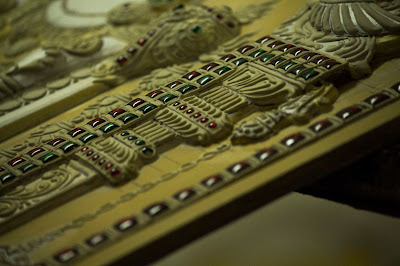
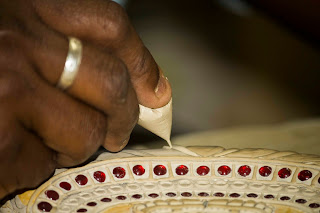
One such artist, Raja, has been practicing this craft for the last 16 years. Working from a tiny room in his house located on south mada road, Thiruvanmiyur, he does the relief work before passing it on to another artist who then adds the gold leaf, color and frames the paintings. Due to the commercialization of the craft, the work is divided amongst artisans to increase the output and reduce the time invested on one painting.
Raja begins the process by smoothening the plywood on which muslin is then stuck using fevicol. A layer of chalk powder mixed with fevicol is applied on the cloth and it is left to dry. It is then coated with arabic gum. After the canvas has been prepped, the drawing is traced on from a gateway sheet to ensure uniformity in the work. Tracing the drawing is also done to save time. Once the drawing is done, depending on whether it’s a flat, semi embossed or 3d embossed, the various layers of chalk powder and plaster of paris are applied. The entire process takes him 2-4 days after which it is packed it thermacol and bubble wrap and sent to the next artist for the further process. The next artist sticks the gold foil on using Arabic gum and then finishes the painting with poster paint. The last thing to be painted on are the god/goddesses eyes as it is believed that once they are painted on the god enters the painting.
 A typical Thanjavur painting consists of one main figure, a deity, with a well-rounded body & almond shaped eyes, which is the typical Dravidian structure. This figure is housed in an enclosure created by means of an arch, curtains etc. The painting is bordered and highlighted by the gilded and gem-set technique - a technique used predominantly in all Tanjore paintings, where gold leaves & sparkling stones are used to highlight certain aspects of the painting like ornaments, dresses etc. The paintings are bright & colourful and breathtakingly beautiful.
Over a period of time many changes have occurred in the style and form of painting - for example, the figures are no longer too round, showing the changed preferences in body structures. Presiding deities of various famous temples are also being depicted in the more recent paintings.
The artists lead simple lives even though Tanjore paintings are very expensive as the middlemen make most of the money, paying the artistes a bare minimum. Moreover, artists who have not been trained in the craft have also started practicing it, which reduces its authenticity. People purchase these paintings, as they are cheaper than the authentic ones. Still they continue to put their heart and soul into each painting they make and because of these efforts made by the modern day artists Tanjore Paintings have become the symbol of traditional paintings. One can say that Tanjore painting is one of the finest and the most visually beautiful forms of classical paintings in South India.
Contact
Name - Mr. Raja
Documented by Anushka Harish Salian
Read More
One such artist, Raja, has been practicing this craft for the last 16 years. Working from a tiny room in his house located on south mada road, Thiruvanmiyur, he does the relief work before passing it on to another artist who then adds the gold leaf, color and frames the paintings. Due to the commercialization of the craft, the work is divided amongst artisans to increase the output and reduce the time invested on one painting.
Raja begins the process by smoothening the plywood on which muslin is then stuck using fevicol. A layer of chalk powder mixed with fevicol is applied on the cloth and it is left to dry. It is then coated with arabic gum. After the canvas has been prepped, the drawing is traced on from a gateway sheet to ensure uniformity in the work. Tracing the drawing is also done to save time. Once the drawing is done, depending on whether it’s a flat, semi embossed or 3d embossed, the various layers of chalk powder and plaster of paris are applied. The entire process takes him 2-4 days after which it is packed it thermacol and bubble wrap and sent to the next artist for the further process. The next artist sticks the gold foil on using Arabic gum and then finishes the painting with poster paint. The last thing to be painted on are the god/goddesses eyes as it is believed that once they are painted on the god enters the painting.
Over a period of time many changes have occurred in the style and form of painting - for example, the figures are no longer too round, showing the changed preferences in body structures. Presiding deities of various famous temples are also being depicted in the more recent paintings.
Contact
Name - Mr. Raja
Contact Number - +(91)-9840541546
Address - 48/67a, South mada street, Thiruvanmiyur, Chennai - 600041, Opposite alm Pranav hotel
Documented by Anushka Harish Salian
Thursday, February 16, 2017
The Undying Art of Temple Umbrellas
No comments:
Labels:
Chennai,
Chintadripet,
craft,
kovil kudai,
Mylapore,
temple umbrellas,
temples
Popularly called the “Gateway to the South India”,Chennai culture is distinctly different from that of any other city in India. Traditional music, dance and all other art forms of Tamil Nadu are very popular in the city. A stroll down the streets of Chintadripet — conceived as a ‘village of small looms’ — and you will see how an old neighbourhood has paused, even if hastily, to take account of time. The neighbourhood is home to a number of heritage structures, including the 19-century CSI Zion Church, the police station, and Chintadripet Higher Secondary School. At least four old temples and families who have been making temple umbrellas and garlands, among other items, for several temples and festivities find a place in the neighbourhood. They claim hereditary rights in making the colourful and elegant umbrellas - Kovil Kudai to dazzle at the Garuda Seva ceremony during the annual brahmotsavam of the world renowned hill shrine of Lord Venkateswara in Tirupati.

But, only about ten to twelve families of artisans based at Chintadripet here are involved in making the umbrellas and have been keeping alive the tradition as the youngsters are no longer attracted to it.
The hand-made umbrellas — excellent pieces of art, are made ahead of the auspicious Tamil month of Purattasi (September-October). This time 13 umbrellas of varying sizes will be sent to Tirupati in a grand procession. The handle, ranging from 7 to 12 feet is made of teak wood, the collapsible parts with cane and the silk-lace work lends charm to the umbrella cover.

“It will take two days to make a small umbrella of seven feet high. Usually, we begin the work after getting orders,” says Kumar, a hereditary artisan. “Only about ten people are involved in making the umbrellas – a tradition passed down to us by our grandfathers,” he adds. These umbrellas are not made by anyone outside their families, Kumar claims. The manufacture is still an intricate handcrafted product. Old traditional ways are still employed. The fingers of many elderly men and women still weave and craft the umbrellas and the design motifs that cover them. Technology has made some of the tasks easier and faster.
Each umbrella is designed with the deity it will be used for. The umbrellas being sent to temples of Vishnu are only in white and redcolor. Those being sent to Siva, Ganesha and Devi temples are multi-colored.The motifs on the umbrella once again find their roots in ancient tradition and stories.

Umbrellas come in many sizes and shapes. There is the flat top to the curved top. The size can be from 4.5 feet to 18 feet. When we see the God or Goddess moving in procession with the huge umbrellas, we truly understand why this ancient art and tradition is still practiced and cherished by the temples and devotees.
Through the ages the making of a temple umbrella has modified and adapted itself to the growing technology and demand. During the olden days only pure silk from Kancheepuram was used to cover the umbrellas today, as the demand for a cheaper and effective umbrella is required materials like satin, velvet and polyester is used. The invent of the embroidery machine plays a big role today as motifs are machine made in a more efficient and faster speed. Even though the evolution has dulled down the actual craft, it is still one of the most respected and sort after South Indian craft. It will always play a major role is various religious processions and ceremonies.
Contact details
Mr. Kumar (Divine temple Umbrellas)
Documented by Vindhya Rk
Read More
But, only about ten to twelve families of artisans based at Chintadripet here are involved in making the umbrellas and have been keeping alive the tradition as the youngsters are no longer attracted to it.
The hand-made umbrellas — excellent pieces of art, are made ahead of the auspicious Tamil month of Purattasi (September-October). This time 13 umbrellas of varying sizes will be sent to Tirupati in a grand procession. The handle, ranging from 7 to 12 feet is made of teak wood, the collapsible parts with cane and the silk-lace work lends charm to the umbrella cover.
“It will take two days to make a small umbrella of seven feet high. Usually, we begin the work after getting orders,” says Kumar, a hereditary artisan. “Only about ten people are involved in making the umbrellas – a tradition passed down to us by our grandfathers,” he adds. These umbrellas are not made by anyone outside their families, Kumar claims. The manufacture is still an intricate handcrafted product. Old traditional ways are still employed. The fingers of many elderly men and women still weave and craft the umbrellas and the design motifs that cover them. Technology has made some of the tasks easier and faster.
Each umbrella is designed with the deity it will be used for. The umbrellas being sent to temples of Vishnu are only in white and redcolor. Those being sent to Siva, Ganesha and Devi temples are multi-colored.The motifs on the umbrella once again find their roots in ancient tradition and stories.
Umbrellas come in many sizes and shapes. There is the flat top to the curved top. The size can be from 4.5 feet to 18 feet. When we see the God or Goddess moving in procession with the huge umbrellas, we truly understand why this ancient art and tradition is still practiced and cherished by the temples and devotees.
Through the ages the making of a temple umbrella has modified and adapted itself to the growing technology and demand. During the olden days only pure silk from Kancheepuram was used to cover the umbrellas today, as the demand for a cheaper and effective umbrella is required materials like satin, velvet and polyester is used. The invent of the embroidery machine plays a big role today as motifs are machine made in a more efficient and faster speed. Even though the evolution has dulled down the actual craft, it is still one of the most respected and sort after South Indian craft. It will always play a major role is various religious processions and ceremonies.
Contact details
Mr. Kumar (Divine temple Umbrellas)
Documented by Vindhya Rk
Tuesday, February 14, 2017
Incense - the scent of the Gods
No comments:
Labels:
agarbatti,
Chennai,
craft,
incense,
incense sticks,
scent
The incense stick- a humble being made with such gentle caring hands, is one of life’s simpler ways of reminding us how we can give someone a beautiful experience when we selflessly give them all we have, when we burn our own hate and ego, to give room for love and affection to blossom.
From time immemorial, man has been fascinated by the fragrance of Nature. In our Hindu mythology, it was a way of life to evoke the blessings of the Almighty for the victory of good over evil. All evil thoughts and portents had to be driven out and the atmosphere cleared of all evil smells. Thus, the habit of burning incense, barks and herbs formed a part of rituals. As times changed, the odoriferous substances became available as Dhoop Mixture. The Southern States of India started rolling this fragrance emitting mixture (Dhoop) over thin splinters or sticks of Bamboo which when lit wafted fragrance through the smoke. These came to be known as Agarbathi / Incense / Joss / Dhoop Sticks and so on.

Chennai is one of the states where agarbattis are still manufactured from scratch. Located in the state of Tamil Nadu, this city has a vast network of artisans who provide incense sticks not only to other cities in India, but also to places all over the globe. One such artist is Mr Kashinath Patwardhan.
Mr Patwardhan’s store is located in the outskirts of Chennai on ECR road. The unit’s name is ‘Vetri Vendhan’. His store is open on all business days and the timing is 8:00am to 7:00pm. You can contact him on- 9944789924.
Patwardhan and his sons inherited this business from his father. The family has been in this business for over 45 years. He believes in sourcing his own materials rather than relying on bulk vendors. That’s one of the reasons why his product is known to have a better quality. The materials used in making an incense stick include bamboo sticks, sandalwood chips, charcoal powder, sawdust, jigat powder and the odiferous mixture called ‘Noorva’.

Noorva can be created by the permutation and combination essence bearing items of natural origin like musk, rose, civet etc. The secret of mixing and preparing the desired Noorva is a part of the family heritage bequeathed from one generation to another.
To make the incense sticks, first the bamboo sticks are washed and processed following which, a bas paste of charcoal powder and sawdust is applied on it and left to dry. Then, the ‘Noorva’ is made, and rolled on to the dry bamboo sticks. The sticks are then left to dry again overnight so that the perfume is evenly absorbed. The finished agarbattis are then packaged and stored for private selling as well as bulk selling to various retailers.
Although it may seem simple, there is a value that makes this craft special. And that is the fact that this craft leaves minimal by-products. Although incense manufacturers may make a wide range of incense sticks, dust is the only primary waste material and is contained by vacuuming and excellent ventilation and reused in the sawdust paste. All paper used in packaging is recyclable.

Today, Patwardhan’s unit makes agarbattis for both religious as well as aromatherapy purposes. He supplies to many healing centres in addition to regular retail stores. He has also started manufacturing less traditional scents like Vanilla, Apple Cinnamon, Blueberry etc. because of its growing demand in the Indian market.
The crux of incense manufacturing has mostly remained unchanged except for the range of fragrances offered. Modern fragrance production allows virtually any scent to be re-created. Also, the popularity of meditation and aromatherapy have spurred incense sales among clients who want their rare moments of quiet and relaxation to be healing and beautifully scented.
Documented by : Mriganka Gupta
Read More
From time immemorial, man has been fascinated by the fragrance of Nature. In our Hindu mythology, it was a way of life to evoke the blessings of the Almighty for the victory of good over evil. All evil thoughts and portents had to be driven out and the atmosphere cleared of all evil smells. Thus, the habit of burning incense, barks and herbs formed a part of rituals. As times changed, the odoriferous substances became available as Dhoop Mixture. The Southern States of India started rolling this fragrance emitting mixture (Dhoop) over thin splinters or sticks of Bamboo which when lit wafted fragrance through the smoke. These came to be known as Agarbathi / Incense / Joss / Dhoop Sticks and so on.
Mr Patwardhan’s store is located in the outskirts of Chennai on ECR road. The unit’s name is ‘Vetri Vendhan’. His store is open on all business days and the timing is 8:00am to 7:00pm. You can contact him on- 9944789924.
Patwardhan and his sons inherited this business from his father. The family has been in this business for over 45 years. He believes in sourcing his own materials rather than relying on bulk vendors. That’s one of the reasons why his product is known to have a better quality. The materials used in making an incense stick include bamboo sticks, sandalwood chips, charcoal powder, sawdust, jigat powder and the odiferous mixture called ‘Noorva’.
Noorva can be created by the permutation and combination essence bearing items of natural origin like musk, rose, civet etc. The secret of mixing and preparing the desired Noorva is a part of the family heritage bequeathed from one generation to another.
To make the incense sticks, first the bamboo sticks are washed and processed following which, a bas paste of charcoal powder and sawdust is applied on it and left to dry. Then, the ‘Noorva’ is made, and rolled on to the dry bamboo sticks. The sticks are then left to dry again overnight so that the perfume is evenly absorbed. The finished agarbattis are then packaged and stored for private selling as well as bulk selling to various retailers.
Although it may seem simple, there is a value that makes this craft special. And that is the fact that this craft leaves minimal by-products. Although incense manufacturers may make a wide range of incense sticks, dust is the only primary waste material and is contained by vacuuming and excellent ventilation and reused in the sawdust paste. All paper used in packaging is recyclable.
Today, Patwardhan’s unit makes agarbattis for both religious as well as aromatherapy purposes. He supplies to many healing centres in addition to regular retail stores. He has also started manufacturing less traditional scents like Vanilla, Apple Cinnamon, Blueberry etc. because of its growing demand in the Indian market.
The crux of incense manufacturing has mostly remained unchanged except for the range of fragrances offered. Modern fragrance production allows virtually any scent to be re-created. Also, the popularity of meditation and aromatherapy have spurred incense sales among clients who want their rare moments of quiet and relaxation to be healing and beautifully scented.
Documented by : Mriganka Gupta
Monday, February 13, 2017
Marapachi Bommai
No comments:
Labels:
bride doll,
Chennai,
craft,
dolls,
golu,
kolu,
marapachi,
wooden dolls,
woodwork
India, home to the world’s largest democracy is a giant amalgamation of life on the move. Part of the lifestyle in India encompasses the monumental importance given to culture and arts. The average Indian lifestyle, in the ancient times, was culturally oriented. Whilst discipline and devotion were morals inculcated in a new-born, the applicative of the same was learning an art or a craft. The same moral is given utmost importance in order to keep alive the spirit of creativity, authenticity, ethnicity and learning. The Indian subcontinent plays the role of a humble abode to a number of forms in the name of the arts and crafts manifested in the nation and around it. With the authentic and indigenous crafts that it possesses, India makes a colossal embodiment of discovered and even so yet to discover arts and crafts
TamilNadu has a rich history of culture and tradition that has evolved over centuries. Perhaps the most profuse flowering of the Tamil culture is in the handicrafts of TamilNadu. By ceaselessly promoting the various ethnic art forms, simultaneously preserving antique artefacts from Chola and Pandya dynasties by reproducing their replicas, Tamil Nadu has become a world-known destination for pilgrims of art in search of fine handiworks of India, such as life-like, Stone Sculptures, Celestial figures in Bronze, Brass lamps, Rosewood Carvings, Sandalwood Carvings, country wood Carvings, Tanjore Art Plates, Tanjore Picture Paintings and much, and much more.
Mylapore the land of Tamil Brahmins, Iyers in particular. St. Thomas Basilica and the Ramakrishna Math (Pronounced as Muth), are some of the places that immediately come to mind when one says ‘Mylapore’.It is an amalgamation of Hindu, Muslim and Christian faiths. It’s a perfect example of secularism amongst the neighbourhoods of Chennai. It is a cultural hub and one of the oldest presidential parts of the city. It is impossible for one to leave Mylapore without gaining any cultural knowledge.


Like any age-old tradition, you can’t help but wonder, what is the significance of Marapachi Bommais? Some believe that these dolls were presented to the bride and the groom at the time of marriage as toys for the couple. After all when two people, rather two children, get married at the age of ten what better gift than toys to keep them happy. Yet another very interesting reason came to my attention while talking to people was, that these dolls dressed in their wedding attire helped in capturing the moment in the days where technology was clearly non-existent. In the absence of pictures, what better way to remember the way you looked when you were married?

The tradition of giving wooden dolls started when child marriage was an essential ceremony in India. Mainly In southern India wooden dolls were gifted to the bride from the groom’s family considering it as a symbol of inviting her in the new family, so that she feels welcomed. There were many other dolls made up of different materials (clay, marble etc.) which were gifted with the marapachi dolls, but the couple dolls had the most importance as it was gifted in a set of two symbolising the bride and the groom.
It is a traditional practice to have wooden figurines of the bride and groom together, called ‘Marapachi Bommai’ or ‘Pattada Gombe’, usually made of sandalwood, teak or rosewood and decorated with new clothes each year before being displayed on the Golu. In southern India, bride is presented with Marapachi Bommai during the wedding by her parents as part of wedding trousseau to initiate the yearly tradition of Navaratri Golu in her new home with her husband. These dolls come as couples dressed in their wedding attire, depicting husband and wife symbolizing prosperity and fertility and the start of the bride’s Golu collection. Display figurines are passed on from one generation to another as heirloom.The significance of this particular gift made of Marapachi doll in red sandal wood is stated to be the medicinal quality of the wood. When a child licks this plaything made of red sandalwood, the child’s saliva derives an extract of the wood which the child absorbs into its system.

The art of creating colourful Kolu dolls and statues has died out. The tradition that has been a part of our culture for centuries, is barely known by half of the population, let alone practiced.
Over the time, lineage of artisans have found it extremely difficult to attract their younger ones in practicing and continuing their hereditary crafts work. They look out for more viable options while pursuing their future, giving minimum importance to the tradition and more towards earning a comfortable livelihood.
The artisans, left in slender numbers, are falling short of work and they tend to resort to repairing the already made dolls instead of making new ones.
Mr. S. Paramasivam : +91 9841945161
Painter and restorer of old golu dolls
Mr Vinodh : +91 9884242203
Running a family business which is three generations old.
Documented by Shreya Singh
Read More
TamilNadu has a rich history of culture and tradition that has evolved over centuries. Perhaps the most profuse flowering of the Tamil culture is in the handicrafts of TamilNadu. By ceaselessly promoting the various ethnic art forms, simultaneously preserving antique artefacts from Chola and Pandya dynasties by reproducing their replicas, Tamil Nadu has become a world-known destination for pilgrims of art in search of fine handiworks of India, such as life-like, Stone Sculptures, Celestial figures in Bronze, Brass lamps, Rosewood Carvings, Sandalwood Carvings, country wood Carvings, Tanjore Art Plates, Tanjore Picture Paintings and much, and much more.
Mylapore the land of Tamil Brahmins, Iyers in particular. St. Thomas Basilica and the Ramakrishna Math (Pronounced as Muth), are some of the places that immediately come to mind when one says ‘Mylapore’.It is an amalgamation of Hindu, Muslim and Christian faiths. It’s a perfect example of secularism amongst the neighbourhoods of Chennai. It is a cultural hub and one of the oldest presidential parts of the city. It is impossible for one to leave Mylapore without gaining any cultural knowledge.
Marapachi dolls, also known as Marapachi Bommais are traditional dolls made of red sandalwood or red wood and are put on display during the Golu festival as a part of Navratri celebrations.These dolls are made in pairs, generally of male and female in naked forms are dressed up by children as part of playthings and displayed during the Golu or “Bommai Kolu” festival. Marapachi Bommais are special dolls that originated in Tirupathi, the land of Lord Venkateshwara. As the influx of raw materials slowed down, the artists started to migrate to various parts of the state and the country. Today in mylapore one can only notice a few artists keeping this art alive. Mr vinodh and Mr. Paramasivam are two such craftsmen who have been based in Mylapore for generations.
Like any age-old tradition, you can’t help but wonder, what is the significance of Marapachi Bommais? Some believe that these dolls were presented to the bride and the groom at the time of marriage as toys for the couple. After all when two people, rather two children, get married at the age of ten what better gift than toys to keep them happy. Yet another very interesting reason came to my attention while talking to people was, that these dolls dressed in their wedding attire helped in capturing the moment in the days where technology was clearly non-existent. In the absence of pictures, what better way to remember the way you looked when you were married?
The tradition of giving wooden dolls started when child marriage was an essential ceremony in India. Mainly In southern India wooden dolls were gifted to the bride from the groom’s family considering it as a symbol of inviting her in the new family, so that she feels welcomed. There were many other dolls made up of different materials (clay, marble etc.) which were gifted with the marapachi dolls, but the couple dolls had the most importance as it was gifted in a set of two symbolising the bride and the groom.
It is a traditional practice to have wooden figurines of the bride and groom together, called ‘Marapachi Bommai’ or ‘Pattada Gombe’, usually made of sandalwood, teak or rosewood and decorated with new clothes each year before being displayed on the Golu. In southern India, bride is presented with Marapachi Bommai during the wedding by her parents as part of wedding trousseau to initiate the yearly tradition of Navaratri Golu in her new home with her husband. These dolls come as couples dressed in their wedding attire, depicting husband and wife symbolizing prosperity and fertility and the start of the bride’s Golu collection. Display figurines are passed on from one generation to another as heirloom.The significance of this particular gift made of Marapachi doll in red sandal wood is stated to be the medicinal quality of the wood. When a child licks this plaything made of red sandalwood, the child’s saliva derives an extract of the wood which the child absorbs into its system.

Over the time, lineage of artisans have found it extremely difficult to attract their younger ones in practicing and continuing their hereditary crafts work. They look out for more viable options while pursuing their future, giving minimum importance to the tradition and more towards earning a comfortable livelihood.
The artisans, left in slender numbers, are falling short of work and they tend to resort to repairing the already made dolls instead of making new ones.
Mr. S. Paramasivam : +91 9841945161
Painter and restorer of old golu dolls
Mr Vinodh : +91 9884242203
Running a family business which is three generations old.
Documented by Shreya Singh
Sunday, February 12, 2017
Granite Stone Carving - Mahabalipuram
No comments:
Labels:
architecture,
Chennai,
figure carving,
Granite,
icon making,
Mahabalipuram,
sculpture,
Stone Carving,
temples
The most ancient and imposing surviving artifacts and monuments are made from stones. Stone carving has been an ancient craft in the Kanchipuram district due to the patronage of religious architecture and sculptures by the ruling dynasties South India. Black and Red Granite are locally available that are used in carving tombstones, letters and gravestones, idols of deities and grinding stones. The skills of carving idols are unique in Tamil Nadu as the carving tradition is still true to translating the sacred scriptures. The beautiful temples that dot the South Indian state of Tamil Nadu have lent the state the sobriquet of “land of temples”.

The art of sculpting runs in the blood of the locals in Mamallapuram. Even today the stone carvers of Tamil Nadu begin with a prayer that first begs forgiveness from Mother Earth for cutting the stone.The stone cutter starts by locating a good stone quarry. Metal pegs are hammered in a straight line into the rock at intervals. Water is poured onto the rock to wet it. The roughly shaped blocks are then transported to the workshop for more careful shaping.The quality of the stone is checked. The way in which the rock is formed dictates its hardness and textures. The easiest to carve are metamorphic rocks that have been changed by compression, heat or chemical action over millennia. This includes soapstones and marble.
 After bringing to the workshop stone is roughly leveled and the figure that has to be carved out is drawn with a mixture of red oxide and water by the meter craftsman. After making a rough figure on the stone they mark exact proportions of the body posture on it. Once the basic form of the idol is carved and chiseled out, the fine details are taken care of. For this, the tools being used are mainly chisel and hammer. Different kinds of chisel - Varying sizes of heads and a hammer according to the size of the chisel. These basic details include the depth the face, the ornaments, the hands and the legs, and depth whatever needed.In every workshop around 300 chisels are estimated to be in use.The surface of the form is now smoothened before finer details are carved onto it and then The final piece of art is polished by rubbing with sandpaper or carborundum stone.After so many process dedication and hard work, the sculpture is ready. It has to be packed properly and delivered to the customer so that it remains safe from inside and nothing gets damaged.
They spend so many days to make a masterpiece which is incredible. The patience that they have and the hard work they do is speechless. It's really not an easy job to do. The craft is in right hands because they do justice to it.The maintained the authenticity of the craft and dedicated their lives to it. The finished sculpture looks so beautiful and the person who sees, they can feel the hard work and dedication behind it.

The people of Mahabalipuram don't perform this craft just to earn money. They do it because they respect it and it is there on their blood. There are many shops that manufacture these sculptures and export to different foreign countries also. So if you are looking for such beautiful sculptures and want to explore this craft, you are at right place. Mr. K. Shanmugam Sthapathy is one the best manufactures who is practicing this craft since 45 years in Mahabalipuram and exports sculptures to Bangkok, Singapore, Malaysia, France, Dubai and many other places. They provide a variety of designs according to the need of the customers and makes sure that the sculpture is made up of the best quality of the stone. Their store and workshop are government approved as it is continuously working on this craft for many years.
Contact
K. Shanmugam Sthapathy
Address: ECR.Kovalam road, Mahabalipuram, Tamil Nadu 603104.
9789048383, 9445735051
Working Hours: 6:00 am To 9:00 pm
Documented by Sanskriti Agarwal
Read More
Granite is an igneous and signature rock and its occurrence is very wide. No other planet other than Earth has this rock type. These stones are tough, hard and second most durable among all the stones and many people use it in construction and making things. They can withstand high temperature and pressure too. Two granite stones are never identical.The granite carving in Tamil Nadu is confined to the area around Mamallapuram (also Mahabalipuram) and Chingleput. The monuments at Mamallapuram comprises of three kinds of Rock Cut Techniques.This may be attributed to the fact that the government has set up the Mamallapuram School of Sculpture here.
The art of sculpting runs in the blood of the locals in Mamallapuram. Even today the stone carvers of Tamil Nadu begin with a prayer that first begs forgiveness from Mother Earth for cutting the stone.The stone cutter starts by locating a good stone quarry. Metal pegs are hammered in a straight line into the rock at intervals. Water is poured onto the rock to wet it. The roughly shaped blocks are then transported to the workshop for more careful shaping.The quality of the stone is checked. The way in which the rock is formed dictates its hardness and textures. The easiest to carve are metamorphic rocks that have been changed by compression, heat or chemical action over millennia. This includes soapstones and marble.
They spend so many days to make a masterpiece which is incredible. The patience that they have and the hard work they do is speechless. It's really not an easy job to do. The craft is in right hands because they do justice to it.The maintained the authenticity of the craft and dedicated their lives to it. The finished sculpture looks so beautiful and the person who sees, they can feel the hard work and dedication behind it.

The people of Mahabalipuram don't perform this craft just to earn money. They do it because they respect it and it is there on their blood. There are many shops that manufacture these sculptures and export to different foreign countries also. So if you are looking for such beautiful sculptures and want to explore this craft, you are at right place. Mr. K. Shanmugam Sthapathy is one the best manufactures who is practicing this craft since 45 years in Mahabalipuram and exports sculptures to Bangkok, Singapore, Malaysia, France, Dubai and many other places. They provide a variety of designs according to the need of the customers and makes sure that the sculpture is made up of the best quality of the stone. Their store and workshop are government approved as it is continuously working on this craft for many years.
Contact
K. Shanmugam Sthapathy
Address: ECR.Kovalam road, Mahabalipuram, Tamil Nadu 603104.
9789048383, 9445735051
Working Hours: 6:00 am To 9:00 pm
Documented by Sanskriti Agarwal
Thursday, February 9, 2017
Salangai Making
1 comment:
Labels:
Chennai,
craft,
dance jewellery,
ghunghroo,
salangai
A Salangai (Tamil) is one of many small metallic bells strung together to form a musical anklet tied to the feet of classical Indian dancers. In Tamil Nadu, the salangai is immediately associated with the Bharatnatyam dance form. Every Bharatnatyam dancer participates in ‘Salangai poojai’ and ‘Arangetram’. The salangai poojai is an important step for any Bharatnatyam dancer. The dancer’s salangai is placed before a deity to be blessed. The salangai poojai takes place before the Arangetram. Arangetram is the debut on-stage performance of a former student of Indian classical dance and music. A string of Salangai can range from 50 to greater than 200 bells knotted together. A novice child dancer may start with 50 and slowly add more as he or she grows older and advances in his or her technical ability.

PROCESS
The process of making salangai is a strenuous and lengthy process. Very few places in our country practice this craft today due to this reason.
The making of salangai begins with the forging of the bronze bells. In Tamil Nadu, the bronze bells are made in Manapparai, a small town near Tiruchirappalli. For making the beads, a separate unique process is followed. Moulds of beads made from mud and cow dung are dipped in a mixture of honey wax, tree sap and castor oil.” Then ‘karuvus’ are dried in the sun for two days. Once the karuvus are dry, they are baked within special mud furnaces for six hours and the bronze, which was placed within the furnace earlier, melts to coat the moulds.’ The mud moulds are cooled and broken away to make hollow bronze beads that are fitted in with iron balls. The men polish the beads because it involves greater physical exertion. The polished beads are then strung on thread into batches of 100 and sold.

These beads are bought by salangai makers and crafted into different types of Salangais. Mr Habeeb is an artisan who lives in Purasawakkam, Chennai. He practices the art of Salangai making. After sourcing the bells, himself and his five apprentices get to work on the salangai. He begins with cutting the leather, sourced from Parry’s, in appropriate sizes. The leather is perforated and stuffed with foam. The bells are then attached to the leather using insulated wire. The leather is folded over the wire and sewn shut. The edges are trimmed to perfection and the golden embellishments are added. Then, Thin strips of leather are attached to the ends for the buckle straps. When the buckles are attached and after a final inspection, the finished salangai is packaged. Mr Habeeb makes salangai with 3 rows to five rows. He also makes the braided salangai that can be tied around the dancer’s feet.
The fluctuation in bronze prices, has forced many of them out of business. Though they buy the metal for Rs.500 per kg today, he says it once used to cost just Rs.30. Their main markets are Tiruchi, Madurai, Kumbakonam and Tanjore, with festivals like the Chithirai Thiruvizha bringing in a boost in sales. But otherwise sales is unpredictable. They are incapable of selling in bulk as they do not have the money to buy the materials in bulk. There are growing concerns over the future of their craft with many of the workers’ children refusing to pursue the craft. The craft is neither patronised by the government nor given financial assistance by banks.

The demand for the product has not decreased, as Bharatnatyam is a very revered and important part of Tamil Nadu’s culture. But due the increase the price of bronze has drastically inflated. Subsidies from the government could help the artisans meet the supply for the demand better. This in turn would help them turn a good profit. If the income from the craft is steady, the children of the artisans may consider following the craft of making salangai, instead of opting for a different career path.
Documented by Adhithi Priya R
Read More

The salangai is made in many different types for the Bharatnatyam dance. Salangai with bells embedded in a swatch of leather is a commonly available type of salangai. The bells are sewn into the leather in three or more rows. More experienced dancers have more rows of bells in the salangai. The salangai has buckles attached to the ends and can be fastened around the dancers ankles. Another type of salangai has the bells strung on a yarn, which is braided together. This type of salangai can be made to any length and cut to the length that the dancer requires. Older, more experienced dancers generally use this salangai. The string of bells can be wrapped around the dancers ankle any number of times.
PROCESS
The process of making salangai is a strenuous and lengthy process. Very few places in our country practice this craft today due to this reason.
The making of salangai begins with the forging of the bronze bells. In Tamil Nadu, the bronze bells are made in Manapparai, a small town near Tiruchirappalli. For making the beads, a separate unique process is followed. Moulds of beads made from mud and cow dung are dipped in a mixture of honey wax, tree sap and castor oil.” Then ‘karuvus’ are dried in the sun for two days. Once the karuvus are dry, they are baked within special mud furnaces for six hours and the bronze, which was placed within the furnace earlier, melts to coat the moulds.’ The mud moulds are cooled and broken away to make hollow bronze beads that are fitted in with iron balls. The men polish the beads because it involves greater physical exertion. The polished beads are then strung on thread into batches of 100 and sold.
These beads are bought by salangai makers and crafted into different types of Salangais. Mr Habeeb is an artisan who lives in Purasawakkam, Chennai. He practices the art of Salangai making. After sourcing the bells, himself and his five apprentices get to work on the salangai. He begins with cutting the leather, sourced from Parry’s, in appropriate sizes. The leather is perforated and stuffed with foam. The bells are then attached to the leather using insulated wire. The leather is folded over the wire and sewn shut. The edges are trimmed to perfection and the golden embellishments are added. Then, Thin strips of leather are attached to the ends for the buckle straps. When the buckles are attached and after a final inspection, the finished salangai is packaged. Mr Habeeb makes salangai with 3 rows to five rows. He also makes the braided salangai that can be tied around the dancer’s feet.
The fluctuation in bronze prices, has forced many of them out of business. Though they buy the metal for Rs.500 per kg today, he says it once used to cost just Rs.30. Their main markets are Tiruchi, Madurai, Kumbakonam and Tanjore, with festivals like the Chithirai Thiruvizha bringing in a boost in sales. But otherwise sales is unpredictable. They are incapable of selling in bulk as they do not have the money to buy the materials in bulk. There are growing concerns over the future of their craft with many of the workers’ children refusing to pursue the craft. The craft is neither patronised by the government nor given financial assistance by banks.
The demand for the product has not decreased, as Bharatnatyam is a very revered and important part of Tamil Nadu’s culture. But due the increase the price of bronze has drastically inflated. Subsidies from the government could help the artisans meet the supply for the demand better. This in turn would help them turn a good profit. If the income from the craft is steady, the children of the artisans may consider following the craft of making salangai, instead of opting for a different career path.
Documented by Adhithi Priya R
Subscribe to:
Posts (Atom)


